

The name Cattleya sounds a bit exotic, doesn’t it? With its overly gorgeous flowers and fragrant aroma, it is destined to be the protagonist of the orchid world. You may still be hesitant: “Is this flower difficult to take care of?” – In fact, it is more friendly than you think, especially for those who are new to the orchid world. Next, we will talk about it slowly from selecting seedlings to daily care, don’t rush.
1. How to pick a Cattleya that is not expensive and easy to grow?
Look at the pseudobulbs, not just the flowers
The pseudobulb is its little reservoir of water, and it must be plump and not shrunken, with no inexplicable wrinkles or black spots on the surface. If it feels limp, then don’t think twice and just skip it.
Root status is critical
Good roots can be identified at a glance – the color is silvery gray or slightly green, and it feels elastic. If you see a black mass with a rotten smell… well, just turn around and walk away.
You have to listen to what the leaf says
Healthy leaves are bright green, and the leaves are strong and crisp. Don’t choose those with yellow or burnt edges, which may indicate sunburn. Also pay attention to darker colors, which are mostly due to lack of light.
Got buds? Buy them!
If you notice a small bump on the top of the stem, don’t hesitate, take it. It will bloom soon, just like buying flowers and getting fireworks for free.
2. The matter of light: sun exposure is not random
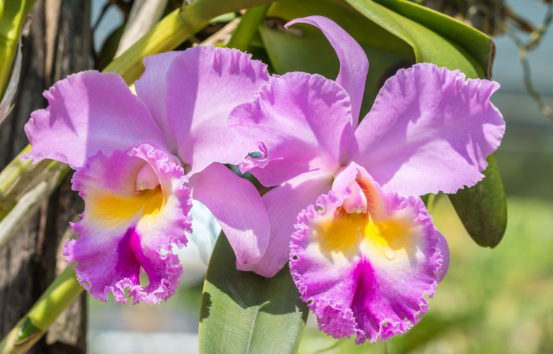
Indirect light is best
Cattleyas are native to tropical rainforests and naturally prefer bright but indirect light. Morning or afternoon sun is fine, but the strong sun at noon? It’s best to let it rest.
Here are some good places to put it:
East or west facing windowsill, the light is mild;
The balcony has a roof, so it is not exposed to direct rain or sun.
Next to the south window, but it should be blocked by a gauze curtain.
The color of the leaves is a hint
Dark green? It says, “I can’t get enough sun!”
Bright apple green? In very good condition;
Yellow spots, brown spots? You’ve sunburned me too much!
3. Don’t be impulsive when watering: water thoroughly only when the soil is completely dry
Unlike some plants that like to drink water every day, Cattleya is more like a person who pays attention to rhythm. Wait until the substrate is almost dry before watering , and water thoroughly when you water, don’t “stop just enough”.
Coarse particles (such as bark)
Generally once every 2-3 days, depending on the ventilation conditions.
Substrate containing peat or moss
It has strong water retention properties and can be left alone for 7-10 days.
The worst thing to do: soak the roots without putting them in water
Many beginners are afraid of drying out, so they just soak the flower pot in water – no! The roots will rot first, and then the whole plant will be ruined. Especially during the flowering period, if you soak it for too long, the flower buds will rot directly.
4. When it comes to fertilizing, be steady and diligent
You can’t expect big flowers to grow by simply spreading fertilizer randomly, you need to know the method.
The safest choices are: special fertilizer for orchids (Orchid Plus, etc.), or a general-purpose 10-10-10 fertilizer (half the concentration).
Growing season : Once a week, don’t be lazy;
During dormancy or after flowering : once every two weeks is enough.
You can also choose sustained-release granules, but remember when using them: don’t be greedy, it’s better to use less rather than more , otherwise the salt will accumulate and harm the flowers.
5. Temperature and humidity: critical but not difficult
They are only willing to bloom when there is a significant temperature difference between day and night.
Large species: 24–29°C during the day, 12–15°C at night;
Small/Mini: 18–24°C during the day and no lower than 15°C at night.
As for humidity? It’s better to keep it between 50% and 70% . If your home is as dry as the northern winter, put a humidifier or water tray next to it, and half of the problem will be solved.
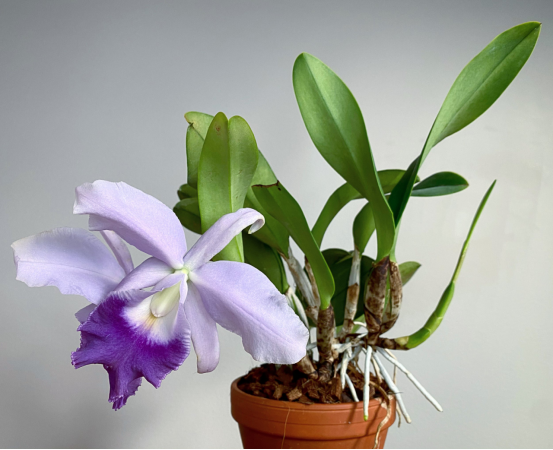
6. When should you repot your plant? Don’t wait until it gets too hot.
When you see these signs, it’s almost time to start:
The roots have grown all over the edge of the flowerpot;
The substrate is moldy, compacted, and not breathable;
The pseudobulbs begin to emerge from the pot.
Note when repotting:
It is best to start in spring , when new buds are about to grow;
only needs to be slightly larger than the old one ;
Don’t save money on the substrate. Bark mixed with perlite and charcoal is the basic configuration, and air permeability is the first priority.
7. Don’t panic if you have a minor bug or disease. You can fix it with action.
Root rot? Take it out, cut off the rotten roots, and replace it with a new pot;
Are there spots on the leaves? Spray some carbendazim, not too strong;
Aphids and spider mites? Use an alcohol swab to apply, or spray with diluted soapy water.
The key point is actually “ventilation”. For most problems, the flowers will feel comfortable once the wind blows and the moisture dissipates.
Conclusion: Cattleya is not that difficult to raise
If you used to think that they are “beautiful, but afraid of trouble when raising them”, that’s not necessary. Grasp a few key points: choose good seedlings, control light and water, know a little about fertilizer, pay attention to temperature difference and humidity, and add a little patience , and you will see the moment when it blooms gorgeously.
So, why not pick one you like now and start a Cattleya journey with its fragrance and color!


