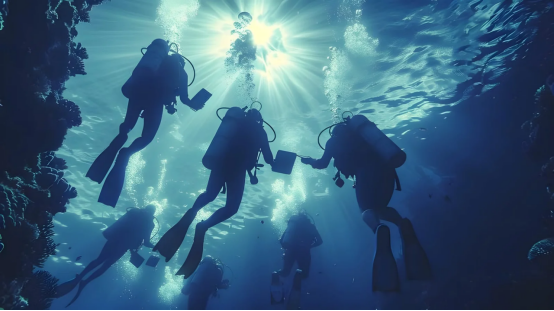
Diving opens up a breathtaking world beneath the waves, but it’s an environment where human physiology is put to the test. Understanding the profound effects of underwater pressure and the risks associated with depth is not just a matter of theory—it’s the foundation of safe and enjoyable diving. Every foot of descent increases the ambient pressure, altering the way gases behave in our bodies and equipment. This comprehensive guide will explore the physics of pressure, its physiological impacts, critical safety procedures, and the unique challenges posed by different diving environments, equipping you with the knowledge to navigate the depths safely.
The Physics of Diving: Understanding Underwater Pressure
The single most important environmental factor in diving is pressure. At sea level, we experience approximately 14.7 pounds per square inch (psi) of atmospheric pressure, referred to as 1 atmosphere (ATA). Water is substantially denser than air, and as a diver descends, the weight of the water column above exerts immense pressure. For every 33 feet (or 10 meters) of descent in saltwater, the pressure increases by another full atmosphere.
Boyle’s Law in Action
The relationship between pressure and gas volume is governed by Boyle’s Law, which states that at a constant temperature, the volume of a gas is inversely proportional to the pressure. This is the most critical gas law for divers to understand. As a diver descends, the increasing ambient pressure compresses the gas in their body’s air spaces (lungs, ears, sinuses) and their equipment. For example, at 33 feet (2 ATA), the volume of a gas is halved. At 99 feet (4 ATA), it is reduced to one-quarter of its original volume. The reverse is true during ascent; as pressure decreases, the gas expands. This principle is the root cause of most pressure-related diving injuries.
Pressure and Gas Density
As pressure increases, the air a diver breathes becomes denser. This has two significant consequences. First, it requires more physical effort to breathe, which can increase fatigue and air consumption. Second, the denser gas means a diver absorbs more nitrogen into their bloodstream and tissues at a faster rate, a key factor in both nitrogen narcosis and decompression sickness.

Physiological Effects of Pressure on the Human Body
The human body is primarily composed of water, which is non-compressible. However, our bodies contain several air-filled spaces that are subject to the dramatic volume changes described by Boyle’s Law. Failure to equalize the pressure in these spaces with the surrounding water pressure can lead to a type of injury known as barotrauma.
Ear and Sinus Barotrauma
The most common diving-related injuries are ear and sinus barotraumas. The middle ear is an air space connected to the back of the throat via the Eustachian tube. During descent, the water pressure pushes the eardrum inward. A diver must actively introduce higher-pressure air from their throat into the middle ear to equalize this pressure. If they fail to do so, the pressure difference can cause pain, fluid leakage, and even a ruptured eardrum.
- Middle Ear Squeeze: Occurs on descent when a diver cannot equalize. Symptoms range from a feeling of fullness to sharp pain and potential eardrum rupture.
- Reverse Block: Occurs on ascent when expanding air is trapped in the middle ear, often due to congestion. This pushes the eardrum outward and can be extremely painful.
- Sinus Squeeze: Similar to an ear squeeze, this happens when congestion blocks the passages to the sinuses. The pressure difference can cause sharp facial pain and bleeding from the nose into the mask.
Lung Over-Expansion Injuries
While squeezes are a risk on descent, the most serious pressure-related injuries occur from expanding air during ascent. If a diver holds their breath while ascending, the expanding air in their lungs can cause a lung over-expansion injury, which is a severe and potentially fatal condition. This can lead to:
- Arterial Gas Embolism (AGE): The most dangerous consequence, where air bubbles are forced into the bloodstream and can travel to the brain, causing stroke-like symptoms.
- Pneumothorax: A collapsed lung, where air leaks into the chest cavity.
- Mediastinal and Subcutaneous Emphysema: Where air is forced into the center of the chest or under the skin, respectively.
The golden rule of scuba diving is to never, ever hold your breath. Always breathe normally and continuously, especially during ascent.
Decompression Sickness (DCS)
Often called “the bends,” Decompression Sickness is caused by nitrogen absorbed by the body’s tissues under pressure. During a dive, high-pressure nitrogen from the breathing gas dissolves into the blood and tissues. If a diver ascends too quickly, the pressure is released too fast for the nitrogen to be safely off-gassed through the lungs. Instead, it forms bubbles in the tissues and bloodstream, much like opening a shaken soda bottle. These bubbles can cause a wide range of symptoms, from joint pain and skin rashes to paralysis and death. Managing DCS risk involves adhering to depth and time limits set by dive tables or a dive computer and performing slow, controlled ascents with safety stops.

Mastering Equalization: Your First Line of Defense
Properly equalizing the pressure in your ears and sinuses is a fundamental skill for every diver. The inability to equalize is a common reason for aborting a dive. It’s crucial to be gentle and proactive, equalizing early and often before any pain is felt.
Common Equalization Techniques
Divers use several methods to open their Eustachian tubes and allow air to enter the middle ear. The most effective technique can vary from person to person.
- Valsalva Maneuver: The most widely taught method. The diver pinches their nose and gently blows, creating pressure in the back of the throat that forces air up the Eustachian tubes. It’s important to be gentle to avoid injury.
- Frenzel Maneuver: A more advanced and often gentler technique. The diver pinches their nose and uses their tongue to act like a piston, pushing air towards the back of the throat and into the nasal passages. This method isolates the pressure from the lungs.
- Toynbee Maneuver: Useful for clearing pressure on ascent or at the surface. The diver pinches their nose and swallows. The swallowing action pulls the Eustachian tubes open.
- Lowry Technique: A combination of the Valsalva and Toynbee methods, where the diver pinches their nose, blows, and swallows simultaneously.
Tips for Easy Equalization
If you have trouble equalizing, there are several things you can do to make it easier.
- Start Before You Enter the Water: Gently equalize on the surface to ensure your ears are clear.
- Descend Feet-First: This orientation makes it easier for air to travel up the Eustachian tubes.
- Look Up: Extending your neck can help open the Eustachian tubes.
- Use a Descent Line: A line allows you to control your descent rate precisely, stopping if you feel pressure.
- Never Force It: If you feel pain, ascend a few feet until the pressure subsides, and then try again. If you cannot equalize, you must safely abort the dive.
- Avoid Diving with Congestion: A cold or allergies can block your Eustachian tubes, making equalization impossible and dangerous.

As Depth Increases: Evolving Risks and Considerations
While the fundamental principles of pressure apply at all depths, certain risks become significantly more pronounced as a diver ventures deeper. Recreational diving is typically limited to 130 feet (40 meters) precisely because of these escalating dangers.
Nitrogen Narcosis
Often referred to as “rapture of the deep,” nitrogen narcosis is an intoxicating effect caused by breathing nitrogen under high partial pressure. The effects are often compared to alcohol intoxication and can include impaired judgment, slowed reaction time, euphoria, and anxiety. While it can occur in shallower water, it typically becomes noticeable for most divers around 100 feet (30 meters). The so-called “Martini’s Law” is a common rule of thumb: for every 50 feet of depth below 66 feet, the effect is equivalent to drinking one martini. The only cure for nitrogen narcosis is to ascend to a shallower depth where the effects will quickly dissipate.
Oxygen Toxicity
While essential for life, oxygen becomes toxic when breathed at high partial pressures. For divers breathing standard air, this is not a concern within recreational depth limits. However, for technical divers using gas blends with higher oxygen concentrations (like Enriched Air Nitrox), it’s a critical consideration. Central Nervous System (CNS) oxygen toxicity can strike with little warning, causing symptoms like tunnel vision, ringing ears, nausea, and, most dangerously, convulsions, which are almost always fatal underwater.
Increased Gas Consumption
Due to Boyle’s Law and increased gas density, a diver’s gas consumption rate increases dramatically with depth. A breath taken at 99 feet (4 ATA) consumes four times the amount of gas from the cylinder as a breath taken at the surface. This means dive times become much shorter at depth, and gas management becomes a far more critical safety consideration.

Essential Underwater Emergency Procedures
Even with meticulous planning, emergencies can happen. Proper training prepares divers to respond calmly and effectively. The core principle in any emergency is to Stop, Breathe, Think, and then Act. Panic is the greatest danger.
Out-of-Air Scenarios
Running out of air is a serious but manageable situation if you are close to your dive buddy. The standard procedure is to signal “out of air” to your buddy and begin sharing air using their alternate air source (octopus). Once sharing air, you should establish positive contact, signal to ascend, and begin a slow, controlled ascent together to the surface.
Equipment Malfunctions
Equipment issues like a free-flowing regulator (where air gushes out continuously) can be alarming. If this happens, do not remove the regulator from your mouth. Keep breathing from it—you will still get air, even if it’s blasting out. Immediately begin your ascent, as you will be losing gas very quickly. For a lost or flooded mask, a diver must be comfortable clearing the mask underwater or completing the ascent without it.
Buddy Separation
If you become separated from your dive buddy, the standard procedure is to look around for no more than one minute. This includes looking up and down, as well as in a 360-degree circle. If you cannot locate your buddy within that minute, you should begin a normal, safe ascent to the surface. In most cases, you will find your buddy waiting there.

Specialized Diving Risks: The Challenge of Cave Diving
While open-water diving has its risks, technical diving disciplines like cave diving introduce a new level of complexity and danger. Cave diving is an overhead environment, meaning a diver cannot make a direct, vertical ascent to the surface in an emergency. This single factor changes everything and requires extensive specialized training and equipment.
Key Dangers of Cave Diving
- Getting Lost: The primary safety tool in cave diving is the guideline. This continuous line to the cave’s exit is a diver’s only way of navigating back out. Losing the line in zero visibility can be a death sentence.
- Silt-Outs: Many underwater caves have fine silt or clay on the floor and ceiling. Improper kicking technique or buoyancy control can instantly stir this up, reducing visibility to absolute zero. A diver must rely entirely on their guideline and tactile senses to find their way out.
- Confined Spaces: Caves often feature tight restrictions that require divers to remove equipment and push it ahead of them. This increases the risk of entanglement and psychological stress.
- No Direct Ascent: Unlike in open water, an out-of-air emergency or serious equipment failure cannot be solved by simply heading to the surface. All problems must be managed at depth while initiating a long exit, making gas management and equipment redundancy absolutely critical.
- Psychological Stress: The darkness, confinement, and knowledge that there is no easy escape can exert immense psychological pressure on a diver. Panic in a cave environment is extremely dangerous.
The Importance of Specialized Training
It cannot be overstated that no one should ever enter an underwater cave without proper cave diving certification from a recognized agency. This training covers essential skills like guideline use, emergency procedures for zero visibility, specialized propulsion techniques, and the mindset required to manage risk in such a demanding environment.
Frequently Asked Questions (FAQ)
- What is the most common injury in scuba diving?
- The most common injury is barotrauma of the ear, often called an “ear squeeze.” This occurs during descent when the diver fails to adequately equalize the pressure in their middle ear with the increasing ambient water pressure. Symptoms can range from mild discomfort to severe pain and eardrum rupture.
- Why do I have to perform a safety stop when I ascend?
- A safety stop, typically a 3-5 minute pause at around 15 feet (5 meters), is a crucial procedure for off-gassing dissolved nitrogen from your body’s tissues in a slow, controlled manner. It significantly reduces the risk of Decompression Sickness (DCS) by allowing the nitrogen to be expelled through your lungs rather than forming dangerous bubbles in your bloodstream and tissues.
- What does nitrogen narcosis feel like?
- Nitrogen narcosis is often described as feeling similar to alcohol intoxication or light-headedness. Divers may experience euphoria, anxiety, slowed thinking, impaired judgment, and a loss of coordination. The effects become more pronounced with increasing depth and can compromise a diver’s ability to respond to problems or monitor their gas supply. The only remedy is to ascend to a shallower depth.
- Can I dive if I have a cold or allergies?
- It is highly recommended that you do not dive while congested from a cold or allergies. Congestion can block your Eustachian tubes and sinus passages, making it impossible to equalize pressure during descent and ascent. Attempting to dive in this condition can lead to severe barotrauma, including eardrum rupture (on descent) or a painful reverse block (on ascent).
- What is the single most important rule in scuba diving?
- The single most important rule is to always breathe continuously and never hold your breath. During ascent, the air in your lungs expands as the surrounding pressure decreases. If you hold your breath, this expanding air can rupture lung tissue, leading to a life-threatening lung over-expansion injury, such as an arterial gas embolism.
Reader boundary: This guide is for general editorial information only. Diving, marine-wildlife, environmental, lighting, electrical, appliance, plant-care, and home-installation topics should be checked against current standards, manufacturer instructions, local rules, and qualified professionals before practical use.