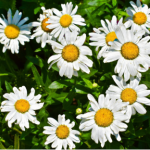
When you mention daisies, you may immediately think of the clean little white flowers in the sun, like a casually painted childhood canvas. But daisies are actually not that monotonous. There are many “relatives” of daisies, ranging from dignified to flamboyant, from elegant to wild, each with its own personality, which makes people want to plant them all at once.
This article is for those who want to carefully choose a “protagonist flower”. Below, we will start with the most classic white daisy and go all the way to those rare blue, purple, and gold series to see which one will “pop” a flower in your heart.
1. White classic: Shasta daisy (Leucanthemum × superbum)
“The queen of daisy world”. The flowers are big and bright, white and yellow, and they look refreshing in the morning. They can grow very tall, up to 90 cm, and look very lively standing in the flower bed. They are also very cold-resistant and easy to care for. They are the type that “give me sunshine and I will bloom”.
Flowering period: spring to summer
Hardiness Zone: Zones 4 to 9

2. Colorful school: Gerbera jamesonii
This “drama queen” may be the most photogenic in the daisy family. The colors range from red, orange, pink, yellow, and purple, and it is as warm as a summer music festival. Although it is afraid of cold, it can bloom from late spring to late autumn in warm areas, making it very suitable for balconies or sun rooms.
Flowering period: late spring to autumn
Hardiness Zone: Zone 8 and above (treat as an annual in cold regions)
3. Tropical sunshine: Golden bush daisy (Euryops pectinatus)
The bush-type daisy looks like the sun planted in the soil. This flower likes to bask in the sun and likes dryness. The hotter it is, the more energetic it is. The gray-green leaves + bright yellow flowers give it a South African seaside style. It blooms almost all year round, so people who keep it should rarely feel lonely.
Flowering period: Four seasons (warm climate)
Hardiness Zone: Zones 8 to 11

4. Exotic Style: Echinacea purpurea
Strictly speaking, it’s not a traditional daisy, but you can recognize it at a glance by its purple-red petals that look a bit “upside down”. Its center is orange-brown, which is visually very striking. Even better, it has medicinal value, and some say it can enhance immunity (but don’t rely too much on it).
Flowering period: late spring to late summer
Hardiness Zone: Zones 4 to 9
5. Wild and natural style: Blanket flower (Gaillardia)
This is the kind of daisy that “looks wild”. It usually appears in desolate places, but its color looks like it was spilled out of an oil painting. It is orange-red with yellow edges, warm and flamboyant, and super sun-resistant. Butterflies and bees also love it. People who like ecological gardening should not miss it.
Flowering period: early summer to autumn
Hardiness Zone: Zones 3 to 10
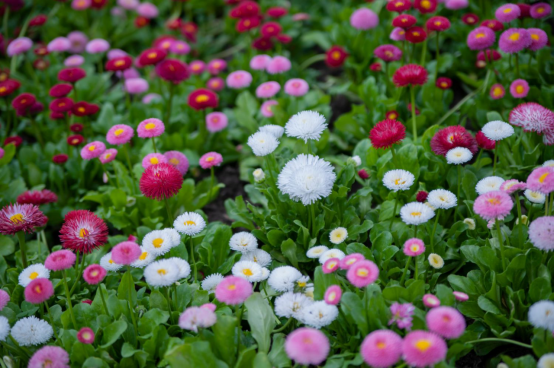
6. Miniature freshness: English daisy (Bellis perennis)
This may be the prototype of the daisy you saw in picture books when you were a child, small and obediently blooming on the grass. It has a variety of colors, from the original white to pink and red horticultural varieties. It is very suitable as a “edging flower” on the edge of the flower bed and is also often used to decorate the lawn.
Flowering season: Spring and summer
Hardiness Zone: Zones 4 to 8
7. Blue Dream Series: Blue Margaret Daisy (Felicia amelloides)
If you think daisies are all sunny, this blue Marguerite will be a surprise. Light blue petals + yellow center, dreamy and playful. However, it is a bit delicate and afraid of cold, so it is suitable for maintenance in the warm climate of the south, or it is also good as a balcony flower ornament in a pot.
Flowering period: mid to late summer
Hardiness Zone: Zone 10 and above
8. Countryside style: Golden Margarite (Anthemis tinctoria)
It is the kind of flower that makes you want to sing “Country Road” when you see it. The yellow flowers bloom naturally and kindly, a bit like a distant relative of chamomile. Paired with blue-purple colors such as lavender and sage, the pastoral feeling is directly maximized.
Flowering period: summer to autumn
Hardiness Zone: Zones 3 to 8
9. Desert toughness: Damianita (Chrysactinia mexicana)
This daisy is one of those “I can live well even if you ignore me” types. It comes from Mexico, is drought-tolerant, sun-resistant, and has its own fragrance, making it particularly popular in gardens in the South or dry areas. It doesn’t require much care to live well.
Flowering season: Spring and autumn
Hardiness Zone: Zones 7 to 11

10. Autumn romance: Aster amellus
If you want your garden to have colors that last into the fall, then aster daisies are worth having. They bloom in delicate and soft colors, ranging from lavender to deep blue, and are not lonely in the autumn breeze. They can also attract pollinating insects, and even deer will not come to bother them. They are simply a “model student” in the gardening circle.
Flowering period: late summer to mid-autumn
Hardiness Zone: Zones 5 to 8
Summary: There are many faces of daisy, and there is always one that looks like the one in your heart
Daisies are not just white. They can be passionate or cool. Garden novices can start with the cold-resistant Shasta daisy; advanced players can try the gerbera or blue daisy. There is always a daisy that will quietly live in your life like a familiar season.
Don’t wait, even if it’s just a small pot on the balcony, starting today, you can plant a mood that blooms all year round.