In many people’s memories, daisies are always associated with good weather. They are like a child’s smile, clean and frank, quietly emerging from the grass, which can brighten people’s mood. They don’t need to be too ostentatious, but they can always leave a gentle impression.
If you are the kind of person who will stay for a few seconds when seeing a daisy – then why not plant one? Don’t worry, this is an entry-level challenge for gardening, which will hardly frustrate you, but may start a light and rich relationship between you and flowers.
This article is written for you and your future daisy – we will start from seeds together and slowly walk to the day when the flowers bloom.
1. Who is Daisy?
Daisy ( Bellis perennis ) is native to Europe and has now settled in temperate zones around the world. The English name “Daisy” comes from the Old English “day’s eye”, which means “eye of the day” – because it only opens during the day and quietly closes at night, like a little sun in the flower world, knowing how to advance and retreat and keeping the rhythm.
Its appearance is simple: a golden flower center surrounded by a circle of white (or colorful) petals. You will feel like you have seen it before, but you can’t help but take another look.
2. Daisy family members suitable for planting
Don’t think that daisies are just the little white flowers you see in the grass. The daisy family is quite large, with different styles to suit different gardening personalities:
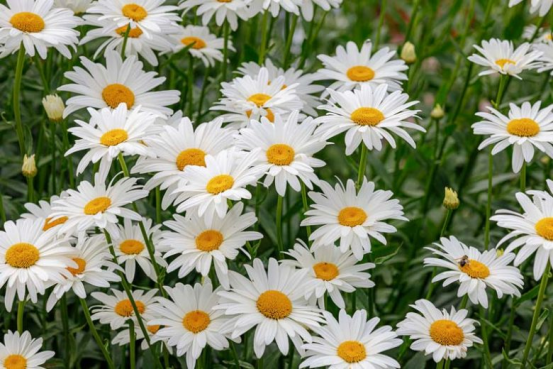
The Shasta daisy (Leucanthemum x superbum)
is the most “daisy-like” representative, with white petals and yellow heart, simple but eye-catching. It blooms in summer and the flowers are particularly large, like the leader of the flower bed.
Common daisy/English daisy (Bellis perennis)
is relatively small, suitable for lawn decoration or edging. It is easy to be mistaken for a wildflower, but it is actually not casual at all.
Gerbera jamesonii
has stunning colors, including orange, red, pink, and purple. It is perfect for display in vases and is a favorite of florists.
Margaret daisy (Argyranthemum frutescens)
is a good friend for potted and balcony planting. It has a very long flowering period and has a gentle feeling of “I am here to accompany you”.
Oxeye daisy (Leucanthemum vulgare)
is a bit wild and suitable for natural style gardens. If you like the temperament of “I am not dressed up but I am beautiful”, you can consider it.
Painted daisies (Tanacetum coccineum)
come in a wide variety of colors, including red, purple, and deep pink, like a fairy tale garden drawn by children.
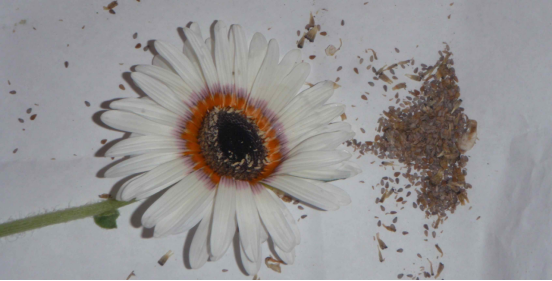
3. Start from seeds: the starting point of everything
For some people, the seed stage is too slow. But trust me, watching a tiny dot grow into a flowering plant is a feeling of accomplishment that can never be replicated.
Sowing time
Best time: Spring , when the temperature is stable at around 21°C . Germination will be faster if the soil temperature is close to above 20°C (about 70°F).
Seeding process
Site selection : Choose a sunny spot. Daisies need light to germinate, so don’t bury them too deep.
Sowing : Sow the seeds directly on the surface of the loose soil and lightly cover with a very thin layer of soil (about 1/8 inch) without compacting it too much.
Soil ratio : The ideal soil is a mixture rich in peat, sand and humus – loose, well-drained and nutritious.
Watering and waiting : Keep it slightly moist, and it will germinate in about 10-20 days. If you are not impatient, it will give you a pleasant surprise.
4. Direct transplant? Yes!
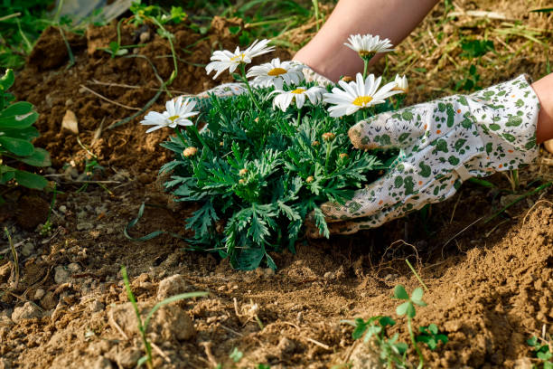
If you really can’t wait, you can also buy seedlings directly from a gardening store and plant them. Choose a plant with a healthy root ball. If you take good care of it, you will see it blooming soon.
Soil Preparation
Loose, nutritious garden soil is the basis. You can mix in an appropriate amount of well-rotted compost or compound fertilizer. In order to prevent drying and weeds, it is also a good idea to cover the surface with a layer of mulch.
Transplanting tips:
Dig a hole slightly wider than the pot and deep enough to fit the root ball.
The roots should not be higher than the soil surface, nor buried too deep, just level with the soil.
Leave at least 30–60 cm between plants to facilitate ventilation and growth.
The first thing to do after planting is to water the plants thoroughly so that the roots can settle down immediately.
5. Key points of subsequent maintenance
Daisies are the kind of plants that are easy to grow and worth taking care of. As long as you don’t forget about them, they usually won’t let you down.
1. Support to prevent lodging
High varieties are prone to falling over in the wind and rain. Don’t be stingy with wooden sticks or small iron wires, a simple bracket can save the situation.
2. Prune dead flowers
If you don’t prune the flowers when they wither, the nutrients will flow to the “memories”. Prune the dead flowers frequently so that new flowers can come in waves.
3. Rebirth by division
After one or two years, daisies will become “too busy” and crowd themselves. In late spring or early fall, dig up the whole plant, cut off the dead parts, divide it into several clumps and replant it, leaving some space between them, so that it will be more comfortable.
4. Keep a balanced watering rhythm
They like moisture but are absolutely afraid of “bathing”. Generally, once a week is enough. You can water them more often when it is hot. But remember: it is safer to keep them dry than to keep them too wet .
6. Some minor troubles and solutions
Not blooming?
Check if there is enough sunlight. Daisies need at least 6 hours of direct sunlight a day to be motivated to bloom.
Leaves turning yellow?
The soil is too wet or the fertilizer is not balanced. Just adjust the rhythm a little, don’t panic.
Are insects annoying?
Aphids and leaf spot are common annoyances. You can spray them with mild soapy water, or manually handle them in the morning with gloves. Don’t wait for insects to establish a “family”, it’s better to intervene early.
VII. Conclusion: A daisy’s gardening journey
Planting daisies is not just for the flowers. It is more like a gentle conversation between you and nature. When you see the small cluster of flowers blooming brightly for the first time, you can’t hide the little pride in your heart.
Whether you grow it on the balcony, in the flower bed, or in a small square pot by the window, daisies will always bring you a sense of “just right life”. It is not complicated or overbearing, but it can accompany you quietly to welcome the joy of the whole season.
So, why not start now and plant the first seed. One day in the future, you will suddenly discover in the white and yellow that life can be so beautiful.