Introduction to Italy’s Garden Heritage
Italy, a land steeped in history, art, and culture, also boasts an extraordinary legacy in garden design. From the opulent Renaissance estates that defined an era of architectural and hydraulic innovation to the specialized botanical sanctuaries preserving rare flora, Italian gardens offer a captivating journey through human ingenuity and reverence for nature. These green spaces are not merely decorative but serve as living museums, reflecting societal values, scientific advancements, and artistic expressions across centuries. The very essence of Italian gardening lies in its ability to blend natural beauty with structured artistry, creating immersive experiences that delight the senses and inspire contemplation.
This comprehensive guide explores two distinct yet equally significant facets of Italy’s horticultural landscape: the awe-inspiring Villa d’Este in Tivoli, a UNESCO World Heritage site renowned for its spectacular fountains and terraced designs, and the exquisite Golden Camellia Garden on Lake Maggiore, a vibrant living plant museum dedicated to the preservation and study of camellia species. Each site tells a unique story, showcasing different eras and approaches to garden creation, yet both underscore Italy’s enduring contribution to the world of landscape architecture and botany.

Villa d’Este: A Renaissance Marvel of Water and Terraces
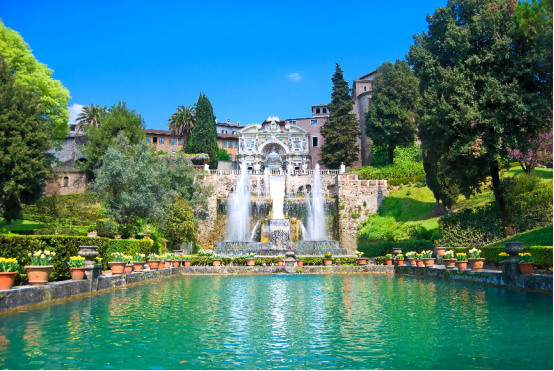
Nestled in Tivoli, near Rome, the Villa d’Este stands as an unparalleled masterpiece of the Italian Renaissance garden. Commissioned by Cardinal Ippolito II d’Este in the 16th century, this villa and its gardens were conceived as a grand statement of power, wealth, and artistic vision. What truly sets Villa d’Este apart is its audacious and intricate use of water, transforming a simple hillside into a “Palace of a Hundred Fountains,” a living, breathing symphony of hydraulic engineering and aesthetic brilliance. The garden’s design principles reflect the prevailing humanist ideals of the Renaissance, drawing inspiration from ancient Roman villas while pushing the boundaries of contemporary technology and art.
The Ingenuity of Hydraulic Engineering
The creation of Villa d’Este’s water features was a monumental feat of engineering for its time. Drawing water from the Aniene River, sophisticated gravity-fed systems, aqueducts, and underground conduits were constructed to power hundreds of fountains, jets, and water games without the use of pumps. This innovative approach allowed for a dynamic and interactive garden experience, where water was not merely an element but the central protagonist. The constant movement and sound of water create a vibrant atmosphere, blurring the lines between natural soundscapes and man-made artistry.
- Fountain of Neptune: A dramatic cascade culminating in powerful jets, representing the god of the sea. Its design was later enhanced in the Baroque period, adding further grandeur.
- The Hundred Fountains (Cento Fontane): A lengthy, three-tiered alley adorned with a multitude of spouts, masks, and mythological figures, creating a continuous, shimmering wall of water that evokes ancient Roman aqueducts.
- The Oval Fountain (Fontana dell’Ovato): A monumental fountain combining architectural elements with natural rock, featuring a large basin and a grotto, often considered the heart of the garden’s hydraulic system.
- The Organ Fountain (Fontana dell’Organo): A truly remarkable innovation, this fountain once played complex musical compositions powered solely by water pressure, astonishing visitors with its mechanical ingenuity and artistic flair.
Terraced Design and Symbolic Landscapes
The terraced layout of Villa d’Este is another defining characteristic, meticulously planned to offer breathtaking panoramic views and create a sense of grandeur as one descends through its various levels. Each terrace reveals new perspectives, hidden grottoes, and elaborate fountain displays, guiding the visitor through a carefully orchestrated narrative. The garden is rich in symbolism, with statues and allegories referencing classical mythology, Roman history, and the Este family’s lineage, effectively turning the landscape into a narrative canvas.
The interplay of architecture, sculpture, and nature within the terraced framework demonstrates a profound understanding of spatial dynamics and visual impact. Pathways, staircases, and hedges are not just functional elements but integral parts of the artistic composition, designed to reveal the garden’s wonders gradually and dramatically. This holistic approach to design ensures that every vista and every sound contributes to an overarching experience of Renaissance splendor.

The Art of Garden Design at Tivoli
The gardens of Tivoli, with Villa d’Este as their crown jewel, exemplify the pinnacle of Renaissance landscape architecture and set a precedent for garden design across Europe. The principles employed here — the manipulation of topography, the harnessing of natural resources, and the integration of art and engineering — became foundational for subsequent generations of garden designers. The emphasis on water as a dynamic element, capable of both soothing and dramatic effects, was particularly influential, inspiring grand estates from Versailles to Peterhof.
Influence and Legacy of Renaissance Gardens
The design philosophy of Villa d’Este, characterized by its formal geometry, alleg